Wyoming Labor Force Trends
January 2026 | Volume 63, No. 1
Click Here for PDF
Return to Table of Contents
Population Migration Flows within Wyoming and Other States
by: Chris McGrath, Senior Statistician
This article will analyze the inflow and outflow migration within Wyoming from 2011-2012 and 2021-2022. To accomplish this, analysts from the Research & Planning (R&P) section of the Wyoming Department of Workforce Services reviewed data from the Internal Revenue Service (IRS) Statistics of Income Division (SOI), in collaboration with the U.S. Census Bureau, to compare population growth and exits within those mountain states.
Beginning in 2011, SOI assumed responsibility for the migration tabulations from the Census Bureau and introduced a number of enhancements intended to improve the data’s overall quality (Pierce, 2015). Migration data are helpful for understanding human movement for policy-making, economic development, and social integration (IRS, 2025).
The SOI migration data methodology is based on comparing year-to-year address changes on individual income tax returns filed with the IRS. To address the changes in taxpayers’ filing positions, the matching process uses the taxpayer identification numbers of the primary, secondary, and dependent filers. Another improvement made to collecting migration flows is through the size of adjusted gross income and age of the primary taxpayer. The Gross Migration File is a summary of the migration flows for each State, plus the District of Columbia, that shows the total number of matched returns, non-migrant returns, outflow returns, inflow returns, and same-state returns (Pierce, 2015).
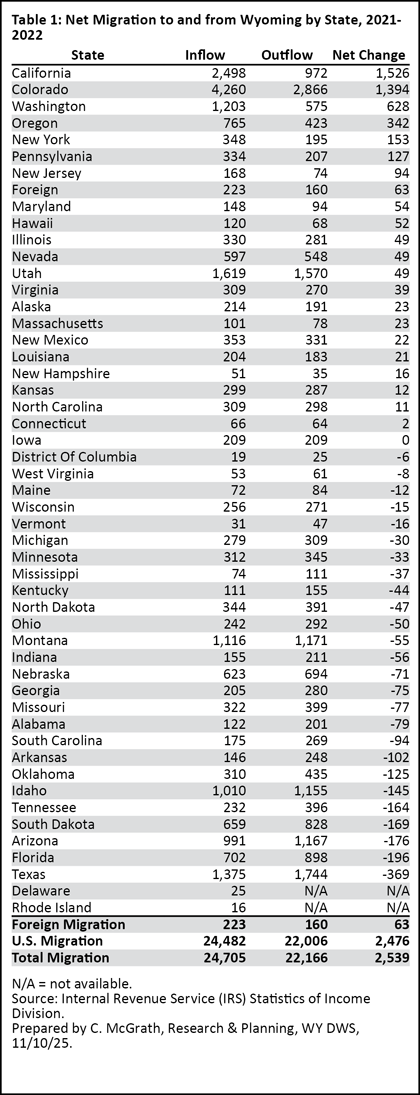
The data presented in this article show population movement patterns by state, providing details on inflow (new residents and their origin into Wyoming) and outflow (residents who left Wyoming and their destination). Net migration is calculated by subtracting the outflow from the inflow. For example, in 2021-2022, there were 623 residents migrating to Wyoming from Nebraska, and 694 leaving to Nebraska for a net change of -71.
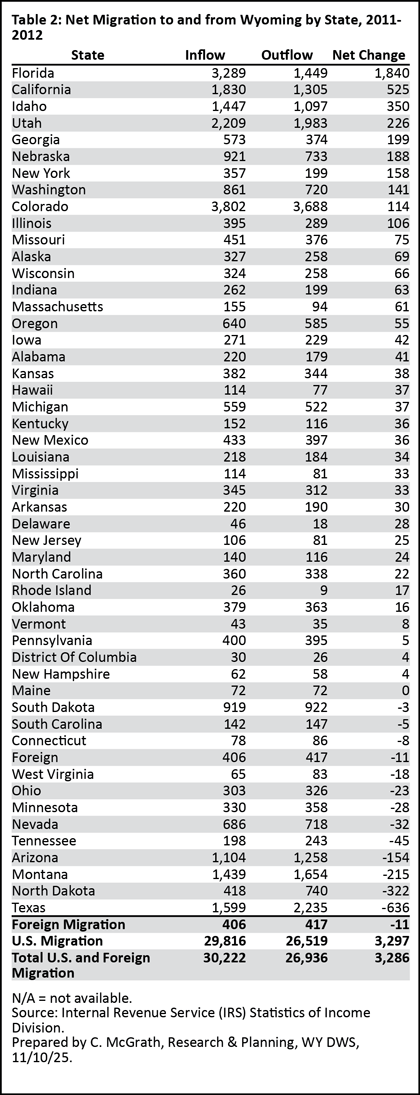
According to data from the IRS SOI and the U.S. Census Bureau, analysts from R&P were able to identify that Wyoming had a total inflow migration of 2,539 people from 2021-2022 (see Table 1), compared to 3,286 in 2011-2012 (see Table 2). In other words, 747 fewer people migrated into Wyoming from 2021-2022 compared to 2011-2012. This is likely due to the jobs available in Wyoming during those periods; in 2011 and 2012, Wyoming added a large number of high-paying jobs in natural resources & mining. In contrast, industries like natural resources & mining, construction, and leisure & hospitality lost a substantial number of jobs during the pandemic.
The largest net in-migration of people into Wyoming (inflow minus outflow) from 2021-2022 came from California (1,526), Colorado (1,394), Washington (628), Oregon (342), New York (153), and Pennsylvania (127). The substantial amount from Colorado could be attributed to post-COVID migration; as noted by Haderlie (2023), “data from the early pandemic years shows that more people migrated into Wyoming than left the state, and most came to the Equality State from Colorado.”
In terms of net out-migration from 2021-2022, the largest number of people left Wyoming for Texas (369), Florida (196), Arizona (176), South Dakota (169), and Tennessee (164). From 2011-2012, Texas also was the top destination for net out-migration (636), followed by North Dakota (322), Montana (215), and Arizona (154). Out-migration to Texas may be an indication of fewer jobs available in Wyoming, but more similar types of jobs available in Texas.
In summary, the data presented in this article show the greatest out-migration was to Texas in 2011-2012 and 2021-2022. Migration into Wyoming was exceptionally higher from Colorado in 2021-2022, possibly due to the effects of the Covid-19 pandemic. Net migration into Wyoming was greater from 2011-2012 than from 2021-2022.
References
Haderlie, C. (2023, February 6). Wyoming saw population influx from Colorado during pandemic, data shows. Gillette News Record. Retrieved December 17, 2025, from https://www.gillettenewsrecord.com/news/wyoming/article_c7b23601-b38b-5788-8f98-0031dd429b5d.html
Internal Revenue Service. (2025, May 7). SOI tax stats — migration data. Retrieved December 17, 2025, from https://www.irs.gov/statistics/soi-tax-stats-migration-data
Pierce, K. (2015). SOI migration data: A new approach. Statistics of Income Bulletin, Summer 2015. Internal Revenue Service. Retrieved December 17, 2025, from https://www.irs.gov/pub/irs-soi/soi-a-inmig-id1509.pdf

 Hire Wyo